

Getting arrested or facing criminal allegations can be stressful for any individual or family. In such situations, understanding how many types of bail in India becomes extremely important. Bail is one of the most essential legal rights available under the Indian legal system, helping protect personal liberty while ensuring that the accused appears before the court during legal proceedings.
In India, bail laws are governed mainly by the Bharatiya Nagarik Suraksha Sanhita (BNSS), previously known as the Code of Criminal Procedure (CrPC). Courts consider several factors before granting bail, including the seriousness of the offense, evidence, criminal history, and the possibility of absconding.
Many people search online to understand the types of bail available in India, but most articles only provide basic definitions. They often miss practical explanations, differences between each bail type, real-life examples, legal procedures, and important court considerations. This detailed guide covers everything in a simple conversational style for Indian readers.
What Is Bail in India?
Bail is a legal process through which a person accused of a crime is temporarily released from custody while the case continues in court. The court may impose conditions to ensure the accused appears during hearings and does not interfere with the investigation.
The purpose of bail is not to declare innocence or guilt. Instead, it balances:
- Individual freedom
- Fair investigation
- Judicial process
- Public safety
The Supreme Court of India has repeatedly emphasized that “bail is the rule and jail is the exception” in many cases involving non-serious offenses.
How Many Types of Bail in India?
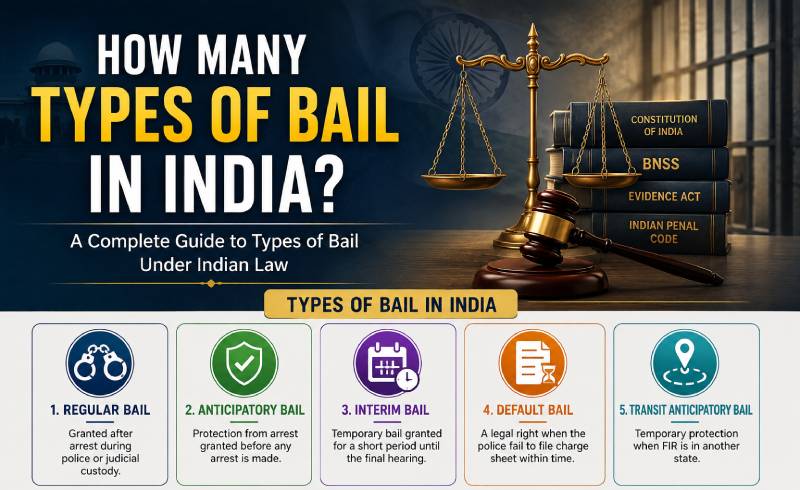
There are primarily three major types of bail in India:
- Regular Bail
- Anticipatory Bail
- Interim Bail
Apart from these, there are additional classifications based on the nature of offenses and court powers, including:
- Default Bail
- Statutory Bail
- Transit Anticipatory Bail
Understanding each category is important because every type serves a different legal purpose.
1. Regular Bail
Regular bail is the most common form of bail in India.
It is granted to a person who has already been arrested and is currently in police custody or judicial custody.
Legal Provision
Regular bail is generally granted under:
- Section 480 BNSS (previously Section 437 CrPC)
- Section 483 BNSS (previously Section 439 CrPC)
When Is Regular Bail Filed?
Regular bail can be filed:
- After arrest
- After police detention
- During judicial custody
- After the filing of an FIR
Who Grants Regular Bail?
Depending on the seriousness of the offense:
- Magistrate Court
- Sessions Court
- High Court
can grant regular bail.
Conditions for Regular Bail
Courts may impose conditions such as:
- Appearing before the court regularly
- Surrendering passport
- Not contacting witnesses
- Not leaving India without permission
Example of Regular Bail
If a person is arrested in a financial fraud case or assault matter and seeks release during the investigation or trial, they apply for regular bail.
2. Anticipatory Bail
Anticipatory bail is one of the most discussed types of bail in India.
It is sought before arrest when a person believes they may be arrested in a criminal case.
Legal Provision
Anticipatory bail is governed under:
- Section 482 BNSS (previously Section 438 CrPC)
Purpose of Anticipatory Bail
The objective is to protect individuals from:
- False accusations
- Political revenge
- Harassment
- Malicious FIRs
When Can Someone Apply?
A person can apply for anticipatory bail when:
- There is fear of arrest
- An FIR may be filed
- Police investigation has started
- Non-bailable allegations are expected
Which Court Grants Anticipatory Bail?
Applications are usually filed before:
- Sessions Court
- High Court
Important Court Considerations
The court evaluates:
- Nature of accusations
- Criminal background
- Possibility of fleeing
- Intent behind allegations
Conditions Imposed
The court may direct the accused to:
- Cooperate with investigation
- Attend police questioning
- Avoid threatening witnesses
- Remain available when required
Example of Anticipatory Bail
If a business dispute escalates and one party fears criminal charges may be filed falsely, anticipatory bail can help avoid immediate arrest.
3. Interim Bail
Interim bail is temporary bail granted for a short period until the final hearing of a regular or anticipatory bail application.
Purpose of Interim Bail
It provides temporary protection to the accused while the court decides the main bail application.
Duration of Interim Bail
Interim bail may be granted:
- For a few days
- For a few weeks
- Until the next hearing date
Why Courts Grant Interim Bail
Courts may grant interim relief when:
- Immediate arrest may cause hardship
- More time is needed for hearing
- The court requires additional documents
Example of Interim Bail
If a court cannot hear an anticipatory bail matter immediately, it may grant interim bail to prevent arrest until the next hearing.
4. Default Bail (Statutory Bail)
Default bail is a legal right available when investigating agencies fail to complete investigations within the prescribed time limit.
Legal Provision
Default bail is governed under:
- Section 187 BNSS (previously Section 167(2) CrPC)
Time Limits for Investigation
Police must complete the investigation within:
- 60 days for less serious offenses
- 90 days for serious offenses punishable with death, life imprisonment, or imprisonment above 10 years
If they fail, the accused gains the right to seek default bail.
Importance of Default Bail
This provision prevents:
- Indefinite detention
- Delayed investigations
- Misuse of police powers
Example of Default Bail
If police fail to file a charge sheet within the statutory period, the accused may apply for default bail regardless of the merits of the case.
5. Transit Anticipatory Bail
Transit anticipatory bail is temporary protection granted when an FIR is registered in another state.
Purpose
It allows the accused enough time to:
- Travel safely
- Approach the appropriate court
- Apply for anticipatory bail in the concerned state
Example
If an FIR is lodged in Delhi while the accused resides in Ahmedabad, a local court may grant temporary transit protection.
Difference Between Bailable and Non-Bailable Offenses
Understanding offense categories is essential while discussing how many types of bail in India.
What Is a Bailable Offense?
In bailable offenses:
- Bail is considered a right
- Police officers can grant bail
- Courts usually approve release quickly
Examples
- Minor hurt
- Public nuisance
- Simple assault
What Is a Non-Bailable Offense?
In non-bailable offenses:
- Bail is not automatic
- Court approval is mandatory
- Judicial discretion applies
Examples
- Murder
- Rape
- Kidnapping
- Serious fraud
Factors Courts Consider Before Granting Bail
Courts in India examine multiple factors before granting any form of bail.
1. Nature of the Offense
Serious crimes receive stricter scrutiny.
2. Evidence Against the Accused
Strong evidence may reduce the chances of bail.
3. Criminal Background
Previous convictions can influence court decisions.
4. Risk of Absconding
Courts assess whether the accused may flee.
5. Possibility of Witness Tampering
Protection of evidence and witnesses is critical.
6. Health and Age
Medical conditions and old age can support bail applications.
Bail Procedure in India
The bail process generally involves the following steps:
Step 1: Filing the Bail Application
A written application is submitted before the appropriate court.
Step 2: Court Hearing
Both prosecution and defense present arguments.
Step 3: Judge Reviews the Case
The judge evaluates:
- FIR
- Evidence
- Legal provisions
- Investigation status
Step 4: Bail Order
The court may:
- Grant bail
- Reject bail
- Impose conditions
Can Bail Be Cancelled?
Yes, courts can cancel bail under certain circumstances.
Reasons for Bail Cancellation
- Violation of bail conditions
- Threatening witnesses
- Committing another offense
- Non-cooperation with investigation
- Attempting to flee
Common Myths About Bail in India
Many misconceptions exist regarding the types of bail in India.
Myth 1: Bail Means Innocence
Reality: Bail only grants temporary freedom during trial.
Myth 2: Bail Is Guaranteed in Every Case
Reality: Courts examine facts before granting bail.
Myth 3: Anticipatory Bail Prevents Investigation
Reality: Police investigation continues even after anticipatory bail.
Importance of Bail in the Indian Legal System
Bail is closely connected to:
- Fundamental rights
- Personal liberty
- Fair trial principles
Without proper bail mechanisms, individuals could face unnecessary imprisonment before conviction
Rights of an Arrested Person in India
Every arrested person has important legal rights, including:
- Right to legal representation
- Right to remain silent
- Right to know grounds of arrest
- Right to medical examination
- Right to seek bail
In many cases, consulting a skilled lawyer for bail helps individuals understand legal remedies quickly and effectively.
Common Mistakes People Make During Bail Proceedings
Many accused individuals unknowingly damage their own cases.
1. Delaying Legal Action
Immediate legal guidance is important.
2. Hiding Facts from the Lawyer
Transparency helps build stronger legal strategies.
3. Violating Bail Conditions
This can result in cancellation of bail.
4. Ignoring Court Dates
Non-appearance can lead to warrants.
Why Understanding Bail Laws Matters
Understanding how many types of bail in India helps individuals:
- Protect legal rights
- Avoid procedural mistakes
- Respond quickly during emergencies
- Understand judicial processes
Legal awareness can make a major difference during stressful situations.
Frequently Asked Questions About Types of Bail in India
Which type of bail is filed before arrest?
Anticipatory bail is filed before arrest.
Is bail possible in non-bailable offenses?
Yes, courts may grant bail depending on facts and circumstances.
Can bail be rejected?
Yes, courts can reject bail if they believe release may affect the investigation or public safety.
What happens after bail is granted?
The accused must follow court conditions and attend hearings regularly.
How long does bail remain valid?
It depends on the court order and type of bail granted.
Conclusion
Understanding how many types of bail in India is essential for anyone dealing with criminal law matters. The Indian legal system provides different forms of bail to balance individual liberty and fair investigation.
The major types of bail include:
- Regular Bail
- Anticipatory Bail
- Interim Bail
- Default Bail
- Transit Anticipatory Bail
Each serves a specific legal purpose and applies under different circumstances.
Courts carefully evaluate every bail application based on evidence, seriousness of allegations, and the conduct of the accused. Knowing the bail process, rights of arrested individuals, and court procedures can help people make informed decisions during difficult legal situations.
With evolving legal reforms and judicial interpretations, bail law continues to remain one of the most important aspects of criminal justice in India.
