

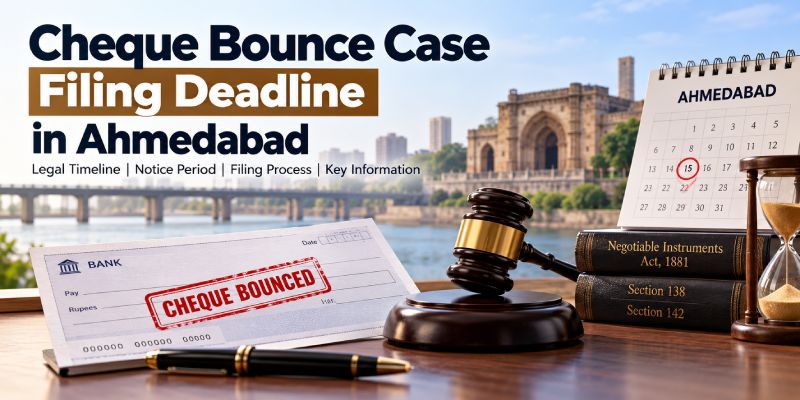
A cheque bounce can create financial difficulties for both individuals and businesses. Whether a cheque is dishonoured because of insufficient funds, an account-related issue, or another legally recognised reason, knowing the correct legal procedure and filing deadline is important for protecting your rights.
In Ahmedabad, cheque bounce cases are generally governed by Section 138 of the Negotiable Instruments Act, 1881. The law sets specific time limits for presenting a cheque, sending a legal demand notice, allowing the drawer to make payment, and filing a criminal complaint before the appropriate court.
The key deadline to remember is that a cheque bounce complaint under Section 138 generally must be filed within one month from the date the cause of action arises after the drawer fails to pay within 15 days of receiving the legal notice. The court may condone a delay if sufficient cause is established, subject to the applicable law.
This guide explains the cheque bounce case filing deadline in Ahmedabad, the legal notice process, important documents, court jurisdiction, and practical steps you can take if your cheque has been dishonoured.
What Is the Cheque Bounce Case Filing Deadline in Ahmedabad?
The cheque bounce case filing deadline depends on several events that occur after a cheque is dishonoured. Section 138 of the Negotiable Instruments Act specifies the conditions that must be satisfied before a criminal complaint can be filed.
The process generally follows these steps:
| Legal step | Applicable time limit |
|---|---|
| Present the cheque to the bank | Within its validity period, generally three months under current banking practice |
| Send a written demand notice | Within 30 days of receiving information from the bank about dishonour |
| Allow the drawer to make payment | 15 days from receipt of the demand notice |
| File the Section 138 complaint | Within one month after the cause of action arises |
These periods are based on Sections 138 and 142 of the Negotiable Instruments Act, 1881. The cheque’s validity, date of notice delivery, and applicable rules for calculating time must be checked in each case.
For the statutory provisions, refer to Section 138 of the Negotiable Instruments Act and Section 142, which governs the filing of complaints and the relevant limitation period.
Understanding the Cheque Bounce Legal Timeline
Understanding the sequence of events can help you avoid missing an important deadline.
Step 1: Present the Cheque Within Its Validity Period
When a cheque is issued to pay a legally enforceable debt or liability, the recipient must present it to the bank within its applicable validity period.
In current banking practice, cheques are generally valid for three months from the date written on them. The statutory wording of Section 138 refers to six months or the cheque’s validity period, whichever is earlier. Because banks generally apply the shorter three-month validity period, you should not wait until six months have passed.
If the cheque is not presented within its validity period, the usual procedure for initiating a Section 138 case based on that presentation may not be available.
Step 2: Obtain the Bank’s Cheque Return Information
If the bank refuses to honour the cheque, it generally provides a cheque return memo stating the reason for dishonour.
Common reasons include:
- Insufficient funds in the account.
- The amount exceeding the agreed banking arrangement.
- Other reasons that may require legal assessment based on the circumstances.
Not every returned cheque automatically results in criminal liability. The reason for dishonour, the existence of a legally enforceable debt or liability, and the other statutory requirements must be examined.
Keep the cheque return memo and any bank communication because these documents help establish the relevant dates.
Step 3: Send a Legal Demand Notice Within 30 Days
After receiving information from the bank that the cheque has been dishonoured, the payee or holder in due course must send a written demand notice within 30 days.
The notice should demand payment of the cheque amount and identify the transaction and dishonoured cheque clearly.
A properly prepared legal notice generally includes:
- The cheque number, date, and amount.
- Details of the drawer and the person entitled to receive payment.
- The reason for the payment demand.
- Details of the underlying debt or liability.
- A demand for payment of the cheque amount.
The notice should be sent using a suitable method that provides reliable proof of dispatch and delivery. Retain the notice, postal receipt, tracking information, and delivery record.
Missing the 30-day notice deadline can create a serious legal problem. If the deadline has already passed, obtain case-specific legal advice rather than assuming that a late notice will be accepted.
Step 4: Allow 15 Days for Payment
After the drawer receives the statutory demand notice, the drawer has 15 days to pay the cheque amount.
During this period, the drawer has an opportunity to settle the demand. If the full cheque amount is paid within the statutory period, the necessary condition for proceeding with a Section 138 complaint based on that default will generally not arise.
If payment is not made within those 15 days, the cause of action arises after the statutory period expires. The next step is to calculate the complaint filing deadline carefully.
Step 5: File the Complaint Within One Month
Under Section 142 of the Negotiable Instruments Act, a written complaint under Section 138 generally must be filed within one month from the date the cause of action arises.
This is the main cheque bounce case filing deadline that complainants in Ahmedabad should understand.
The limitation period is not simply one month from the date the cheque bounced. It is linked to the statutory process, including the legal demand notice and the drawer’s failure to pay within 15 days of receiving it.
A lawyer can help calculate the relevant dates, prepare the complaint, organise supporting documents, and determine the court with jurisdiction.
Can You File a Cheque Bounce Case After the Deadline?
Yes, a delayed complaint may still be considered in certain circumstances.
The proviso to Section 142(1)(b) of the Negotiable Instruments Act allows a court to take cognizance of a complaint filed after the prescribed period if the complainant satisfies the court that there was sufficient cause for not filing within time.
However, condonation of delay is not automatic. The court examines the reasons for the delay and decides whether they justify accepting the late complaint.
If you have missed the one-month filing period, consider taking the following steps:
- Collect the cheque, bank return memo, demand notice, and delivery records.
- Prepare a clear timeline of the events and identify the reason for the delay.
- Consult a lawyer promptly to assess whether a request for condonation of delay is appropriate.
- Obtain advice on the correct procedure and supporting documents for your circumstances.
Do not deliberately postpone legal action on the assumption that the court will condone the delay. Acting within the prescribed period is generally the safer approach.
Which Court Handles Cheque Bounce Cases in Ahmedabad?
The court with jurisdiction depends on the statutory rules and the facts of the transaction.
Under Section 142(2) of the Negotiable Instruments Act, where the cheque is deposited for collection through the payee’s bank account, jurisdiction generally lies with the court within whose local jurisdiction the branch where the payee or holder maintains the account is situated. Different rules apply where the cheque is presented for payment otherwise than through an account.
Therefore, a cheque bounce complaint in Ahmedabad should be filed before the court that has jurisdiction under the applicable provisions. The correct court should be verified from the bank account details, the manner of presentation, and the relevant transaction records.
An advocate familiar with cheque dishonour proceedings can help determine the appropriate court and prepare the complaint in accordance with the applicable procedure.
Documents Required to File a Cheque Bounce Case
Preparing the relevant documents in advance can make the legal process more organised.
The documents commonly required include:
- Original cheque: The cheque issued by the drawer.
- Cheque return memo: The bank’s record of dishonour.
- Copy of the legal demand notice: The notice sent within the statutory period.
- Proof of notice dispatch and delivery: Postal receipts, tracking records, or other relevant evidence.
- Transaction documents: Agreements, invoices, loan records, purchase orders, or other evidence of the underlying liability.
- Payment records: Bank statements, receipts, or account entries that support the transaction.
- Identity and address details: Relevant particulars of the complainant and drawer.
- Supporting correspondence: Messages, emails, or written communications relating to the payment.
The precise documents required will depend on the facts of the case and the court’s procedural requirements. Keep the originals safe and provide your lawyer with complete, accurate information.
What Happens After Filing a Cheque Bounce Complaint?
Once the complaint is filed, the court examines the complaint and supporting material in accordance with the applicable law and procedure.
Depending on the case, the process may involve:
- Scrutiny of the complaint and supporting documents.
- Consideration of whether the statutory requirements are satisfied.
- Issuance of process to the accused where legally appropriate.
- Court appearances and consideration of the parties’ submissions.
- Evidence, examination, and other proceedings as required.
- Settlement, compounding where legally permissible, or a final judicial decision.
The duration of a cheque bounce case varies depending on the court’s schedule, the complexity of the dispute, the parties’ participation, and other procedural factors. It is not possible to guarantee a particular outcome or completion date.
What Is the Punishment for Cheque Bounce Under Section 138?
Where the requirements of Section 138 are satisfied and the accused is convicted, the law provides for imprisonment for a term that may extend to two years, a fine that may extend to twice the amount of the cheque, or both.
The actual outcome depends on the evidence, applicable law, and the court’s decision. A cheque being dishonoured does not by itself establish that every legal requirement for conviction has been met.
The parties may also explore a lawful settlement where appropriate. Any settlement should be documented properly, and its effect on the pending proceedings should be addressed through the correct legal process.
Why Is Timely Legal Advice Important in a Cheque Bounce Case?
Cheque bounce matters involve strict statutory timelines and documentary requirements. An error in calculating the notice period, filing the complaint, or identifying the correct court may affect the proceedings.
A lawyer can assist with:
- Calculating the legal notice and complaint filing deadlines.
- Drafting and sending a statutory demand notice.
- Reviewing the evidence of a legally enforceable debt or liability.
- Preparing the complaint and supporting documents.
- Identifying the appropriate court in Ahmedabad.
- Advising on settlement options and the next procedural steps.
If you are searching for the best lawyer in Ahmedabad for a cheque dishonour dispute, assess the lawyer’s experience with Negotiable Instruments Act matters, familiarity with local court procedures, communication, and fee transparency. A lawyer for cheque bounce case proceedings should be able to explain the relevant deadlines and legal options without promising a guaranteed result.
A criminal lawyer in Ahmedabad may also be able to assist where the matter requires representation in criminal proceedings under Section 138.
Common Mistakes to Avoid in Cheque Bounce Cases
Even when the underlying transaction is genuine, procedural mistakes can complicate a claim. Avoid these common errors:
1. Waiting too long to send the notice
The statutory demand notice must generally be sent within 30 days of receiving information about the cheque’s dishonour.
2. Calculating the complaint deadline from the wrong date
The one-month limitation period is linked to the cause of action after the drawer fails to pay within 15 days of receiving the notice, not simply the date of dishonour.
3. Ignoring proof of delivery
Maintain reliable records showing when and how the notice was dispatched and delivered.
4. Filing in the wrong court
Check the jurisdiction rules under Section 142 and confirm the correct court before filing.
5. Assuming every cheque return is a criminal offence
The cheque, underlying liability, reason for dishonour, notice, and other statutory conditions must be assessed together.
6. Assuming a delay will automatically be excused
The court must be satisfied that sufficient cause exists before it can condone a delay in filing.
Frequently Asked Questions About Cheque Bounce Case Filing Deadlines in Ahmedabad
1. How many days do I have to file a cheque bounce case in Ahmedabad?
Generally, a complaint under Section 138 must be filed within one month from the date the cause of action arises. Before that, the payee must send a demand notice within 30 days of receiving information about dishonour and allow the drawer 15 days from receipt of the notice to pay.
2. Is the cheque bounce case deadline one month or 30 days?
Section 142 refers to one month for filing the complaint, while Section 138 specifies 30 days for sending the demand notice. These are separate statutory periods and should not be treated as interchangeable. The applicable rules for calculating the dates should be checked in the particular case.
3. Can I file a cheque bounce case without sending a legal notice?
A statutory demand notice is generally a necessary condition for a complaint under Section 138. The notice must meet the applicable requirements and be sent within the prescribed period.
4. What happens if the drawer does not pay within 15 days?
If the drawer fails to pay the cheque amount within 15 days of receiving the statutory demand notice, the cause of action generally arises after that period expires. The complainant can then proceed with filing a complaint within the limitation period prescribed by Section 142.
5. Can I file a cheque bounce case after one month?
A court may condone a delay if the complainant establishes sufficient cause under the proviso to Section 142(1)(b). Acceptance is not guaranteed, so seek legal advice promptly.
6. Where should I file a cheque bounce complaint in Ahmedabad?
The appropriate court depends on the jurisdiction provisions of Section 142(2), including how the cheque was presented and the location of the relevant bank branch. Confirm the correct court based on the actual facts.
7. What is the time limit for sending a cheque bounce legal notice?
The written demand notice must generally be sent within 30 days of receiving information from the bank about dishonour.
8. What is the punishment for cheque bounce in India?
Under Section 138, conviction may result in imprisonment of up to two years, a fine of up to twice the cheque amount, or both, subject to the facts and applicable law.
9. Can a cheque bounce case be settled outside court?
The parties may explore a settlement, and offences under Section 138 are compoundable under Section 147 of the Negotiable Instruments Act. The settlement and any steps required to conclude the court proceedings should be handled properly.
10. Should I consult a lawyer immediately after a cheque bounces?
Early legal advice is useful because the statutory notice and complaint deadlines depend on specific dates and procedural requirements. Keep the cheque, return memo, and transaction records available when seeking advice.
Conclusion
The cheque bounce case filing deadline in Ahmedabad depends on following the statutory process under Sections 138 and 142 of the Negotiable Instruments Act, 1881. The main steps are presenting the cheque within its validity period, sending a written demand notice within 30 days of receiving information about dishonour, allowing 15 days for payment after receipt of the notice, and filing the complaint within one month after the cause of action arises.
If a deadline has already passed, do not assume that all legal options are lost. The law permits a court to condone a delayed complaint in appropriate circumstances, provided sufficient cause is established.
Review your documents, confirm the relevant dates, and obtain legal advice based on the facts of your case. Prompt action can help you understand your available remedies and follow the correct procedure.
